The Ceiling Is a Convection Oven: What Actually Breaks When a Bristol Kitchen Scales Up
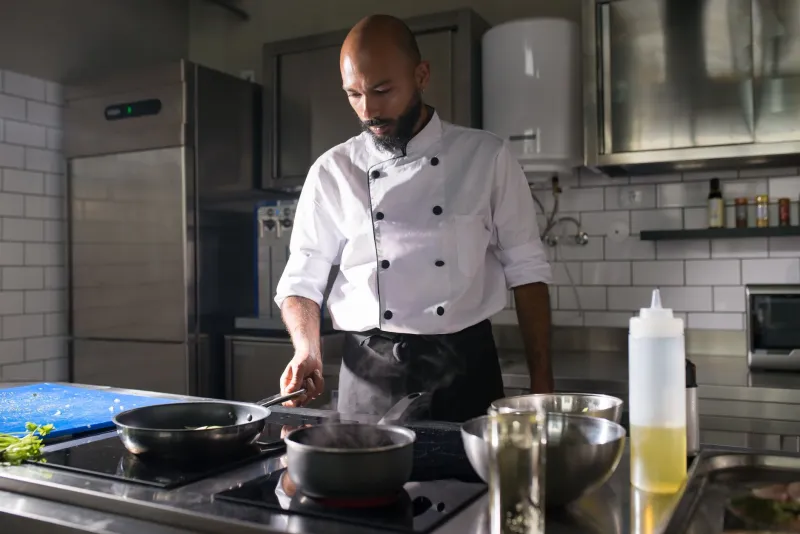
There is a particular kind of optimism that lives in a community kitchen at about half past four on a Thursday. The curry is on. Someone's auntie has brought a bag of spinach. A volunteer is cutting a loaf into slabs, and the whole thing smells like the best possible version of the city. Then someone says the sentence that starts all the trouble: "We could easily do this for two hundred."
We could not easily do this for two hundred. Not in this kitchen, not with this oven, not with these six people and one and a half hours before the doors open. And yet the ambition is right — the demand is real, the waiting lists are real, the need is real. So the useful question isn't should we scale. It's what actually breaks first when we do.
Twenty portions is a recipe. Two hundred is a production run.
They look like the same task with a bigger number in front. They are not the same task at all. A recipe is a set of instructions written for a domestic kitchen and a domestic appetite for risk. A production run is a logistical system with bottlenecks, hot-holding times, batch numbers and a person whose actual job is to stand there with a probe thermometer and say no, not yet.
The gap between the two is where most of Bristol's community food plans quietly come apart — usually at about the ninety-portion mark, and usually in front of the people the meal was for.
Where it snaps
The heat, not the recipe
A hall kitchen in Easton or Knowle West typically has one domestic-style oven, four hob rings and a microwave. That is enough to hold maybe forty plated meals in a service window if you're lucky and organised. Multiply the recipe by ten and you have not multiplied the oven. You've just made a bigger queue for the same heat.
What you need — and what almost nobody budgets for — is a bratt pan or a tilt skillet for the onions, a proper convection oven with three or four racks, and enough gastronorm pans to hold everything. A 15kg batch of onions will not caramelise in a domestic pan. It will steam, sulk, and turn into a grey slurry two hours before service. That's not a flavour problem, it's a surface-area problem.
The onion is the clock
Thirty kilos of onions, diced, is roughly two hours of solid knife work for two competent people. That is your entire volunteer window gone before anything hits a flame. Professional kitchens solve this by buying prepped — which costs money and feels wrong to a project built on surplus and thrift. The honest middle route is a food processor, a decent mandoline and a rota that doesn't start at 5pm.
Salt doesn't scale like cumin
Here's one that catches people out. If your twenty-portion recipe calls for four teaspoons of cumin and the batch for two hundred needs forty, fine. But if it calls for two teaspoons of salt, forty teaspoons will wreck it. Salt, chilli heat and stock powder all scale sub-linearly because the surface area of the food doesn't grow the way the volume does, and because palates are more sensitive than arithmetic. Season at 70–80% of the linear multiple, taste at each stage, and write the batch numbers down on the wall so the next person doesn't guess.
Spices need blooming in fat, and you can't bloom forty teaspoons in a pan that fits four. Toast and grind in batches, or make a base masala paste once a fortnight in bulk and portion it.
The bottleneck is the pot wash
Everyone plans the cooking. Almost nobody plans the washing up. Feed two hundred people and you generate roughly six hundred items of crockery, cutlery and serving kit, plus every pan, board and tub used to get there. If your kitchen has one small domestic dishwasher and a single sink, you have planned a lovely meal and a two-hour argument.
Racking, a pass-through dishwasher, a hose with a spray head, and a dedicated pot-wash volunteer who is thanked as loudly as the cook — these are the unglamorous purchases that decide whether a project can repeat.
Hot holding, and the four-hour window
Food has to be held above 63°C or cooled fast and chilled. That means hot cupboards, probe thermometers, labels, and someone with the authority to delay service. Scaling up also scales up the time food sits around, which is exactly when things go wrong. Serving in two sittings, thirty minutes apart, is almost always safer and calmer than one heroic push.
The playbook that holds
Cost per portion, not cost per recipe. Build a simple sheet: every ingredient, every kilo, divided by portions actually served — not portions planned. Bristol projects that do this routinely discover their real number is 40–60p higher than the funding bid assumed, and that the gap sits in oil, spices, cleaning supplies and gas.
Cook the base, finish in batches. One big base sauce made on Tuesday, portioned and chilled, finished with fresh vegetables, beans or protein in four oven trays on the day. Same flavour, four small risks instead of one enormous one.
Split the service. Two sittings, two teams, two wash-ups. It is gentler on volunteers and kinder to the queue.
Write the prep list backwards. Start at the time the doors open and work back in fifteen-minute blocks. Anything that doesn't fit is a thing you're not cooking.
Buy the boring equipment first. Trolleys, trays, lids, labels, probes, a second fridge, a decent dishwasher. The pot is never the problem. Everything around the pot is.
Keep a dignity rule. However the food is scaled, it gets plated or served at a table, not ladled into people's own containers in a corridor. Bulk is not an excuse for a scrum.
And sometimes the answer is two hundred portions across two kitchens, two days and two neighbourhoods. That's not a failure to scale. That's a network doing what a single pot can't.
What funders should hear
Bristol's community kitchens aren't short of recipes. They're short of coordinator hours, capital equipment and core funding that pays for a dishwasher rather than a launch event. If the city wants affordable meals at volume in 2026, the money needs to follow the bottlenecks — heat, washing up, cold storage and the person with the clipboard.
The pot was never the hard part. It's everything the pot needs around it.