The Friday Tab: Bristol's Corner Shops and the Credit That Never Gets Counted
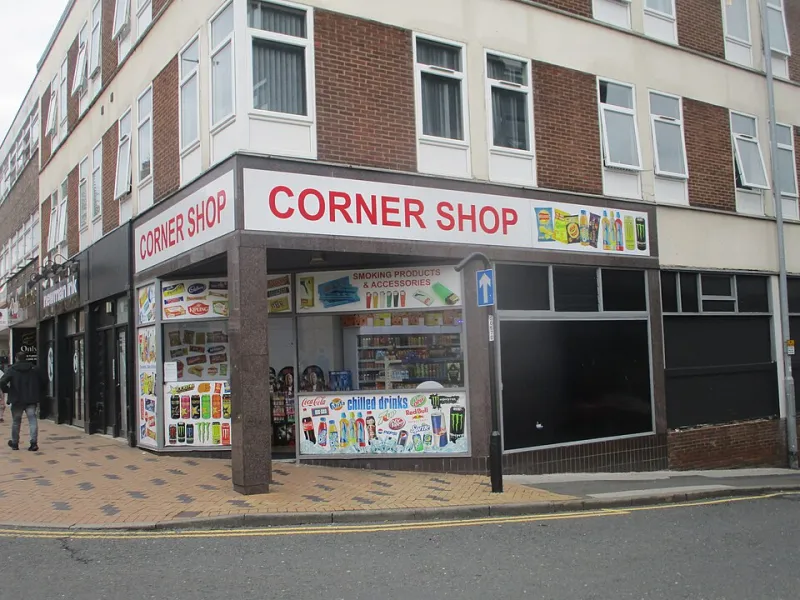
Photo: Mtaylor848, CC BY-SA 4.0, via Wikimedia Commons
On a wet Tuesday on Stapleton Road, a shopkeeper reaches under the counter and pulls out a loaf she has kept back since the morning. It is not a reservation in any formal sense. There is no app, no loyalty card, no receipt. There is just a name, a nod, and a line in a notebook that says Friday. By Friday, the customer will pay — or they won't, and the shopkeeper will decide whether to carry the debt into next week. Either way, nobody in a council office will ever count it.
This is Bristol's invisible food safety net. Not a charity, not a food bank, not a pilot scheme with a logo. It is a ledger kept behind tills in Easton and Bedminster, Hartcliffe and Fishponds, Lawrence Hill and Knowle. It is the pack of mince split in half because someone only has enough for half. It is the tin of tomatoes that goes on the tab. It is the shopkeeper who knows which customer gets paid on the last Thursday of the month and which one is waiting on a universal credit decision that has gone quiet.
The ledger behind the till
Corner shops have always extended informal credit, but the food-justice angle is easy to miss because it looks like ordinary neighbourliness. A customer is £3 short. The shopkeeper says, bring it Friday. The customer comes back. The relationship holds. Over time, that small act of trust becomes a form of food security — not generous enough to solve poverty, but flexible enough to stop a bad week becoming a crisis.
The mechanics are varied. Some shops keep a paper notebook. Some use a text message thread. Some simply remember. The terms are usually interest-free and short. A few shops cap the tab at a tenner; others stop when a customer misses two Fridays. The most important thing is not the amount of credit. It is the absence of a means test. Nobody asks for a bank statement. Nobody is made to sit in a waiting room. Nobody has to explain why the money ran out.
That matters because the formal food safety net is often designed around proof. Proof of income. Proof of address. Proof of crisis. The corner-shop ledger runs on a different currency: familiarity, repetition, and a willingness to absorb a small risk. It is not romantic — it can be patchy, awkward, and dependent on the shopkeeper's own cash flow — but it is real infrastructure. It just doesn't look like infrastructure.
Why it stays off the spreadsheet
The obvious policy response is to formalise it. That would be a mistake if formalising means turning shopkeepers into credit providers with compliance paperwork and customers into data points. Informal credit works precisely because it is low-friction. If every Friday tab requires an affordability assessment and a digital record, most of it will disappear. The people who need it most will be left with nothing but the same old choice: payday loan, food bank, or skip a meal.
There are risks on both sides. For shopkeepers, unpaid tabs are a direct hit to already thin margins. A few bad weeks can turn a gesture of trust into a cash-flow problem. For customers, informal credit can become a source of shame, or a relationship that is hard to exit if the shopkeeper starts applying pressure. The line between I'll hold a loaf for you and you owe me is thin. Good shops keep it on the right side. Policy should help them do that, not pretend the ledger doesn't exist.
There is also a data problem. The informal ledger never appears in food insecurity statistics, local food strategies, or wholesale planning. That means the shops doing the most flexible work are also the least supported. They absorb risk that should be shared. They patch gaps that should be filled by wages, benefits, and secure housing. And because their work is invisible, it is easy for policymakers to claim the city's food response is more complete than it is.
The co-op wholesale lever
One way to strengthen the ledger without formalising it is to attack the cost side. Independent shops buy in small volumes, which means they pay more per unit than the supermarkets. A cooperative wholesale buying club — several shops pooling orders for staples like bread, pasta, rice, tinned tomatoes, oil, and milk — could lower those costs and stabilise margins. That extra headroom is exactly what allows a shopkeeper to hold a loaf back without feeling foolish.
Bristol already has a co-operative instinct in its food scene. The next step is to connect it to the till, not just the boardroom. A buying club doesn't need to be glamorous. It needs a shared order sheet, a delivery day, and enough trust to split a pallet. If it works, it gives corner shops the same bulk-price advantage that chains take for granted. That is a food-justice intervention hiding inside a wholesale invoice.
A local food guarantee could go further. Not a new benefits system, and not a charity fund that makes customers perform gratitude. A capped guarantee — maybe a few thousand pounds per shop, underwritten by a council, an anchor institution, or a community fund — could reimburse a share of written-off food tabs. In exchange, shops would agree to simple terms: no interest, no harassment, a fixed cap, and a referral route to advice services. The guarantee would absorb the risk that currently sits on the shopkeeper's shoulders, while keeping the relationship human.
The design matters. A guarantee that requires customers to register, prove need, or accept surveillance would defeat the point. It should be behind the scenes: the shopkeeper keeps the ledger, the fund covers a portion of the losses, and the customer keeps their dignity. That is not soft policy. It is practical risk-sharing. It recognises that food security is built not only in council chambers but in the daily arithmetic of a shop till.
What good support looks like
A useful local food guarantee would pass four tests. First, it would be capped and interest-free, so it doesn't create a new debt trap. Second, it would reimburse shops without punishing customers — no blacklist, no public naming. Third, it would link to advice and cash-first support, because a Friday tab is not a substitute for enough money. Fourth, it would be accountable to the neighbourhoods it serves, not just to the institutions funding it.
None of this replaces the need for decent wages, secure housing, and a social security system that doesn't leave people waiting weeks for money they are owed. But it does something important: it recognises the work already happening in Bristol's corner shops and asks how to share the risk more fairly. The ledger behind the till is not a solution to food poverty. It is a pressure valve. A good city should know where its pressure valves are — and make sure they don't burst.
So next time you see a shopkeeper put something aside for a regular, don't call it charity. Call it what it is: a small, unsung piece of Bristol's food infrastructure. The question is whether we build the wholesale prices, the guarantees, and the local policies that let it keep going — without turning the person behind the counter into a debt collector.